Travel mapping
How Many Countries Have You Visited?
Airport connections, territories, and day trips can make a simple country total surprisingly complicated. Choose a rule you can explain while keeping the places and memories behind the number.
Updated
Start with what you want the number to mean
“How many countries have you visited?” sounds like a question with one numerical answer. Then someone asks whether a connection counts, whether you need to stay overnight, or whether a territory should have its own entry. Two people can agree on every trip and still arrive at different totals.
For a personal travel map, the useful approach is to choose a counting rule you can explain, apply it consistently, and keep the underlying places even when they do not contribute to the headline number. Your travel history can be more detailed than the number on a Passport card.
You do not need to settle every unusual case before starting. Record the trips you remember, make a few clear choices, and leave yourself room to correct the record later.
A country list is a convention
The United Nations has 193 member states, which gives many travelers a familiar starting list. Other lists also include observer states, dependencies, overseas territories, or places with separate travel identities. Those lists are answering slightly different questions.
A map also needs geographic entries that go beyond a simple membership list. A trip to a territory should be searchable and recognizable even if your preferred country total groups it with another place or excludes it from the count.
This is why comparing two app totals without checking their settings can be misleading. The difference may come from the list, the visit rule, or a missing trip. It does not automatically mean one app lost your history.
The most useful question is often: which places account for the difference?
Decide what counts as a visit
There is no universal rule for a personal travel diary. A travel club or challenge may publish its own rules; use those if that is the list you are trying to complete. For your own atlas, choose the rule that describes the history you want to keep.
Here are three workable approaches:
- Physical presence: count any place where you were on the ground, including transit. This is broad and easy to state, but an airport connection can look the same as a long holiday in the total.
- Time outside transit: count a place when you left the airport, station, or other connection setting and spent time there. This is a useful middle ground for many personal maps.
- A deliberate visit: count destinations you intentionally explored. This is more subjective, so notes help with brief stops and older trips.
An overnight requirement is another possible rule, but it can exclude a substantial day trip while including a short airport-hotel stop. Time spent is useful context; it does not automatically explain the experience.
Write your rule in a sentence. “I count places where I spent time outside transit, and list territories separately” is easier to apply than deciding again every time the number is close to a milestone.
What about layovers and driving through?
An airside connection and an afternoon exploring a city are different experiences, even when both happened between flights. You can preserve both in a trip record without giving them identical meaning in your country total.
| Situation | A useful way to record it |
|---|---|
| Four hours in an airport without leaving transit | Keep it as a connection if useful; apply your visit rule to the country total. |
| A long layover with time spent in the city | Record the city and date, then count it if it meets your rule. |
| A road trip across a country with brief stops | Keep the route and stops; decide whether passing through qualifies. |
| A day trip without an overnight stay | Record it normally if your rule does not require a night there. |
| Flying over a country | A view from the plane can be a memory without becoming a ground visit. |
The same judgment matters when importing photos. A located picture can establish where the camera was, but it cannot tell whether you left the terminal or intended to visit the place. Review airport and in-flight evidence before accepting it into a visited map.
Keep territories visible when changing the count
Mapsake's Countries & Territories list separates the inventory of recorded places from the subset included in your count. This is the distinction behind the recent country-list improvements.
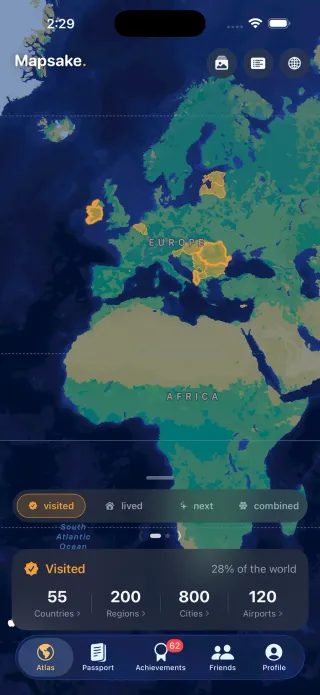
Open the places list in the Atlas and look at Countries & Territories. All recorded shows the entries in your history, including territories excluded by your counting preferences. Counted only narrows the list to the entries contributing to the total. The list shows recorded and included totals separately, with inclusion information on the rows.
A Country count settings are available from that list. Adjusting a counting preference changes how the total is presented; it does not erase the saved visit, its dates, or the reason the place appeared in your history.
That lets you keep a detailed record of a territory while using a narrower headline count. There is no need to delete the trip merely to make the number match your preferred convention.
Build the list from several kinds of evidence
Photos are a useful starting point because dates and coordinates can recover trips you would otherwise enter one by one. They are still an incomplete source. Older cameras may have no GPS, some exports strip metadata, and a place you visited without taking a photo remains a real visit.
Use a few sources together:
- Review located photos. Check the proposed countries, regions, and cities before confirming an import.
- Add missing trips manually. Use dates and notes you can support rather than inventing precision for an old memory.
- Check existing records. A supported travel-history export can fill gaps left by the photo library.
- Remove misleading evidence. Photos received from another person or taken in transit may not belong in your personal visited map.
- Compare the finished list with your counting rule. Investigate unexpected entries before concentrating on the total.
If photos are missing locations, start with the iPhone photo-location guide. A lack of GPS is a reason to use another source, not a reason to discard the trip.
Make a simple map before building a full atlas
For a quick shareable picture, open the free country selector in Photo Map Maker. Choose the countries you want to show, review the map, and download the image. You can make the map without selecting any photos.
The browser tool is useful for a lightweight visual list. It does not reproduce every country-count preference in the app or carry the same dated trip history. Treat its selected-country map as its own result, especially if your personal list includes territories or a particular counting convention.
The Mapsake app is the better fit when you want the dates, places, photos, and return visits behind the picture to remain editable over time.
Let the detail outlive the number
A country total can be a satisfying way to see progress. It is a much smaller thing than the history behind it. Returning to a familiar city may add no country to the count and still be the trip you most want to remember.
Keep the places, explain the convention when sharing the number, and change the count through settings rather than removing valid history. A useful atlas should still make sense after you decide to count a little differently.